

A Ripple IPO in 2026 is mechanically plausible — but current evidence points firmly against it. Here is everything you need to know about the valuation scenarios, the regulatory backdrop, and what it all means for XRP token holders.
Executive Summary: Why "Plausible" Is Not the Same as "Likely"
Speculation around a Ripple Labs initial public offering has reached a fever pitch heading into 2026. The settlement of the long-running SEC lawsuit, the broader crypto bull market, and a string of high-profile crypto company listings have all fueled the narrative that Ripple is next in line for Wall Street. The reality, however, is more nuanced.
A 2026 IPO for Ripple Labs is plausible in a mechanical sense — the company has the size, the brand recognition, and now the regulatory clarity to pursue a public offering. But it looks strategically unlikely on currently available evidence. Ripple's own leadership has repeatedly and publicly dismissed the IPO path, and the company's recent financial moves strongly suggest it simply does not need public-market capital right now.
This article breaks down the valuation scenarios, the regulatory context, the timeline reality, and — critically — what any IPO outcome would actually mean for people who hold XRP.
What Ripple's Own Leadership Has Said
Any honest analysis of a Ripple IPO has to start with what the company's president has said on the record. In a widely cited interview on Bloomberg Crypto, Monica Long explicitly pointed to Ripple's strong balance sheet and access to private capital as the reasons why a public listing is not the primary driver of corporate strategy. She framed public-market liquidity — historically the main "why IPO" argument for late-stage tech companies — as a need that Ripple has already solved through other means.
"We have a strong balance sheet. We have access to private capital. The main reasons companies go public don't really apply to us in the same way right now." — Monica Long, President of Ripple Labs (Bloomberg Crypto)
This is not a throwaway comment. It reflects a deliberate and consistent corporate posture: stay private, preserve flexibility, avoid the disclosure obligations and quarterly earnings pressure that come with being a public company. Until that posture changes at the executive level, treating a 2026 IPO as a base case would be a mistake.
The Private Capital Move That Changes the Equation
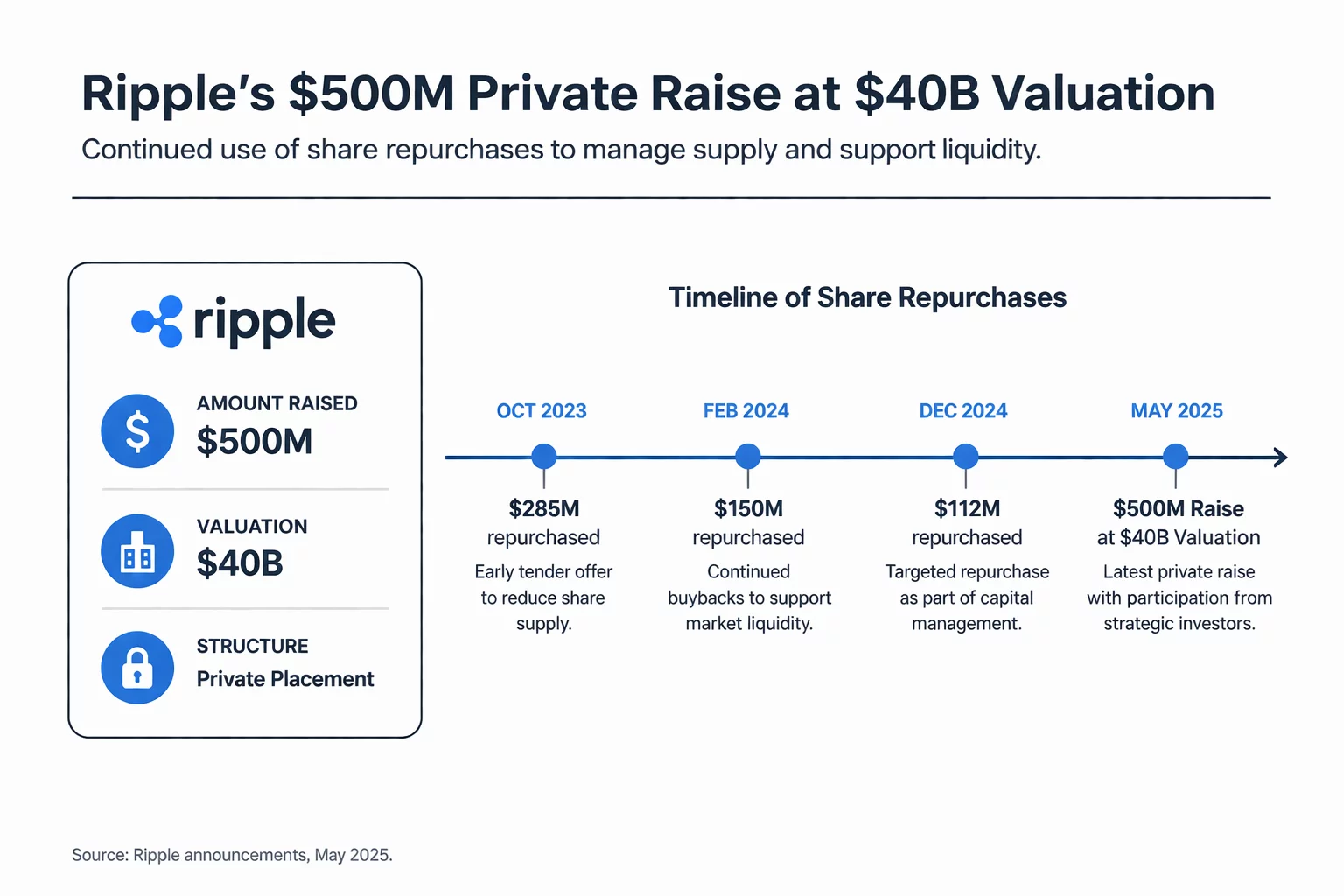
Words are one thing; capital allocation is another. In November 2025, Ripple announced a $500 million strategic investment at a $40 billion valuation. That single transaction tells you almost everything you need to know about why the IPO urgency is low.
The deal did two things simultaneously. First, it established a credible, third-party-validated private valuation — giving institutional investors, employees, and counterparties a reference price without requiring the company to open its books to public scrutiny. Second, it provided the kind of balance-sheet firepower that companies typically seek from an IPO. With $500 million in fresh capital at a $40 billion headline valuation, Ripple has no obvious funding gap that a public offering would fill.
The company has also been actively managing shareholder liquidity on the private side, conducting tender offers and share repurchases — including buying back more than 25% of shares in recent years. That level of internal liquidity management further reduces the pressure to create a public market for the stock. For employees and early investors who might otherwise push for an IPO exit, the tender offer mechanism provides an alternative path.
Regulatory Overhang: Cleared, But Not Forgotten
For years, the single biggest obstacle to any Ripple IPO — or any major corporate move — was the Securities and Exchange Commission lawsuit filed in December 2020. The SEC alleged that XRP was an unregistered security, creating existential uncertainty around the company's core product and business model.
That picture has changed materially. In May 2025, the SEC announced that it had filed a settlement agreement framework with Ripple and two of its executives. The framework contemplated dissolving an injunction from an August 7, 2024 district court judgment, releasing an escrowed civil penalty, and — critically — dismissing appeals pending in the Second Circuit, pending approval from the district court and appellate courts.
This is a significant de-risking event. The regulatory overhang that made Ripple effectively unlockable for public-market institutional investors — pension funds, mutual funds, and index-tracking vehicles that cannot hold securities with unresolved regulatory liability of this magnitude — has been substantially reduced. In that sense, the legal path to an IPO is now meaningfully clearer than it was in 2020, 2021, 2022, or 2023.
But the settlement also illustrates why timing matters. The legal resolution is still working through the court system. And even with the SEC cloud lifted, Ripple management's public stance remains "stay private." Legal clearance is a necessary condition for an IPO, not a sufficient one.
The XRP Position Problem: A Structural Complexity Investors Must Understand
Here is the issue that most mainstream IPO coverage misses entirely, and it is the one that institutional equity investors will spend the most time on in any pre-IPO due diligence process.
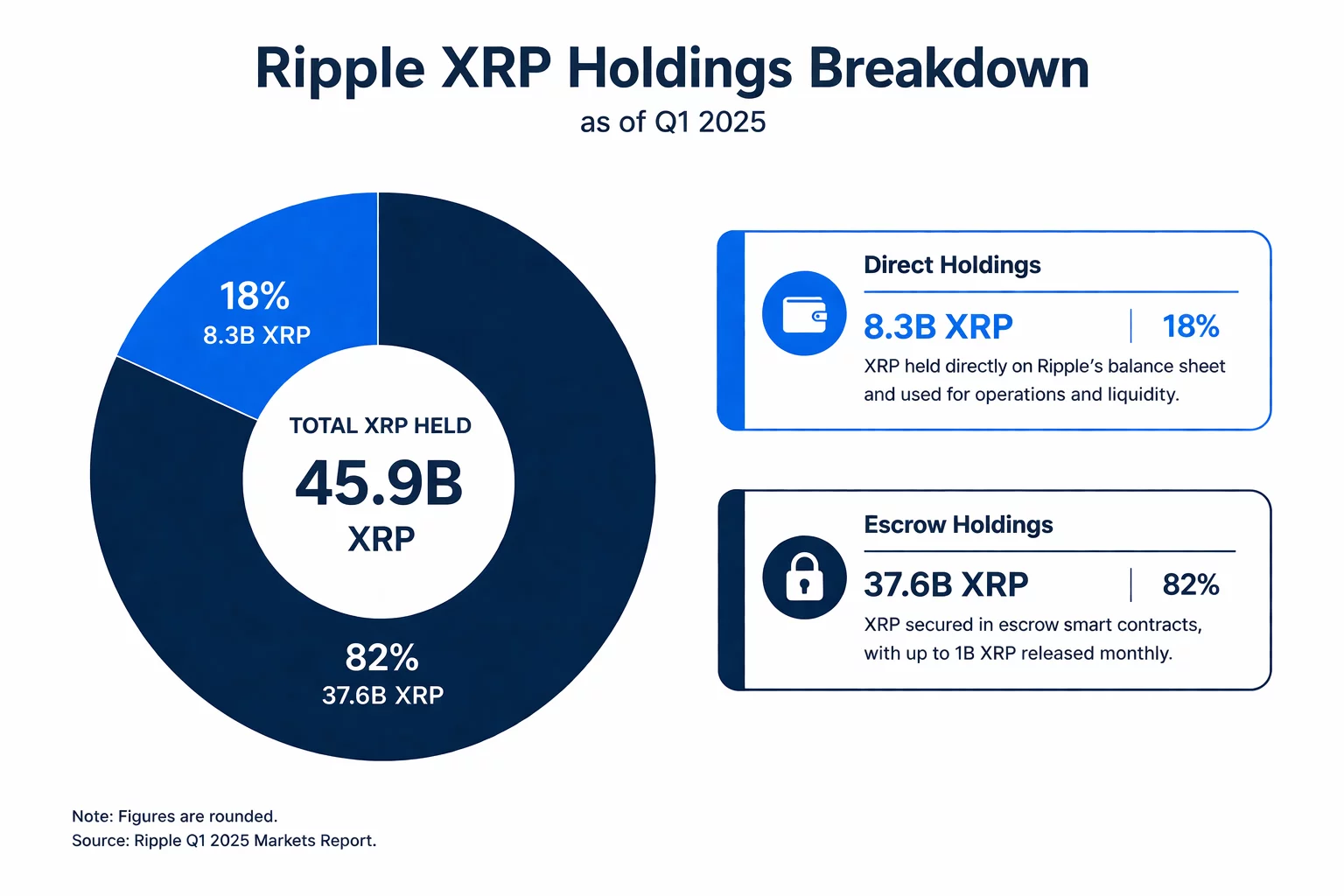
Ripple holds an extraordinarily large XRP position relative to its private-market equity valuation. As of March 31, 2025, the company held 4.562 billion XRP directly, with an additional 37.130 billion XRP subject to on-ledger escrow — a total of approximately 41.692 billion XRP under Ripple control, with escrow releasing on a scheduled monthly basis.
Why does this matter for an equity IPO? Because small changes in the market's "effective, realizable value" assigned to that XRP position can swing Ripple's implied equity value by several billions of dollars. This creates three distinct analytical problems for public-market investors:
- Disclosure complexity: Public companies must mark their asset positions to market on a regular basis. A multi-billion-dollar XRP holding that fluctuates with crypto market cycles would create significant earnings volatility and require extensive footnote disclosure in SEC filings.
- Token overhang perception: Public investors may price in the risk that Ripple sells XRP to fund operations, creating a persistent "overhang" discount on both the equity and the token.
- "XRP vs. Ripple equity" substitution: Institutional investors who want Ripple exposure can already buy XRP directly. A Ripple equity IPO would force a conversation about what the equity offers that the token does not — and the answer is complicated by the fact that XRP holders have no direct claim on Ripple's equity or earnings.
Valuation Scenarios: What Would Ripple Actually Be Worth?
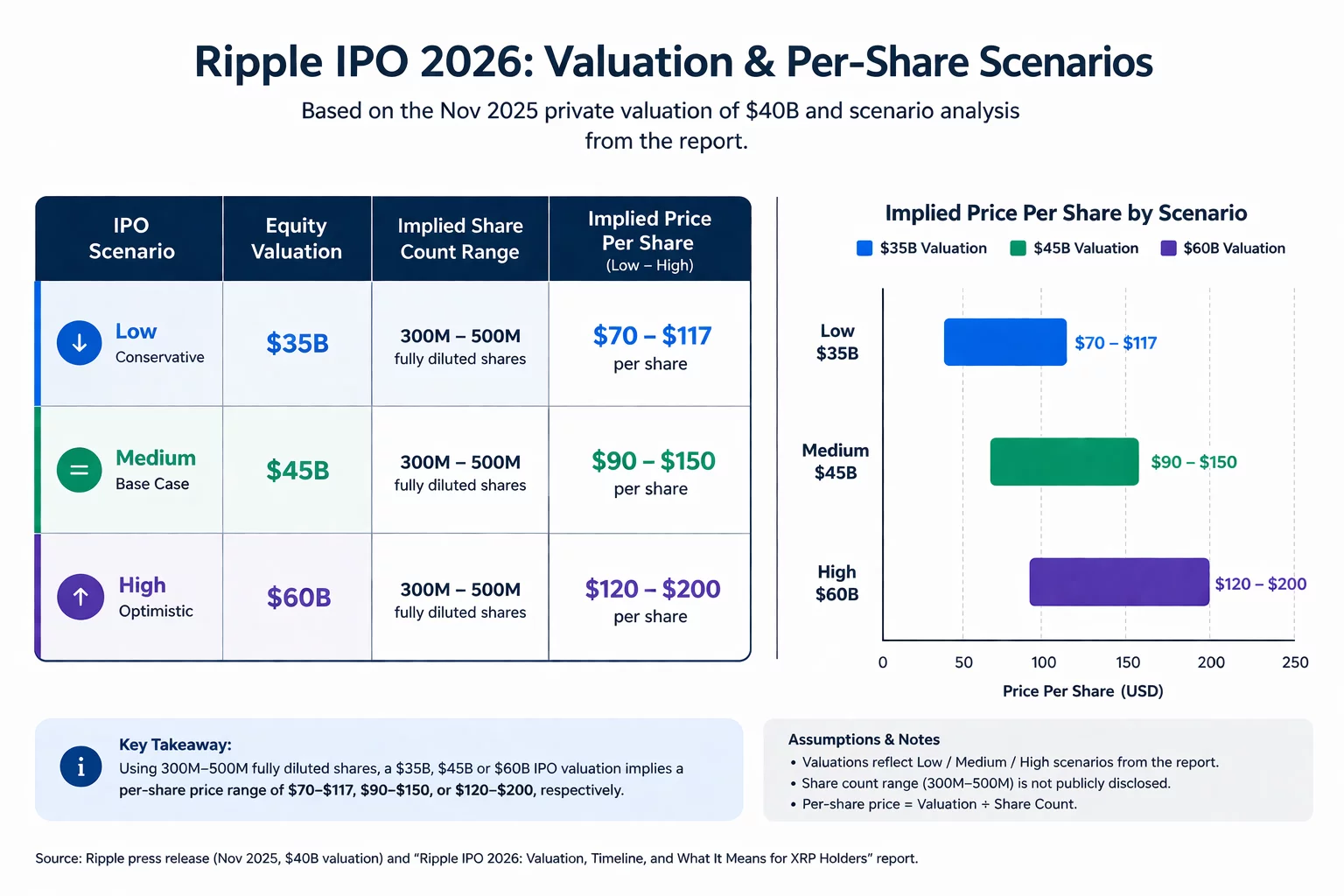
For investors and XRP holders trying to model what a Ripple IPO would look like, three illustrative valuation scenarios are worth examining. These scenarios use a hypothetical IPO window and are anchored to Ripple's disclosed $40 billion private valuation from the November 2025 raise, institutional investor profiles from comparable crypto-adjacent public companies, and precedent IPO multiples.
Low Scenario: $35 Billion
A low-end outcome would likely reflect a difficult macro environment for tech IPOs, a compressed multiple due to XRP overhang concerns, or a situation where the broader crypto market has pulled back from cycle highs. At $35 billion, Ripple would be pricing its equity at a discount to its last private round — not unprecedented for high-profile tech IPOs, but not a strong signal for the XRP market either.
Mid Scenario: $45 Billion
A mid-range outcome essentially validates the November 2025 private valuation with a modest public-market premium. This would be consistent with a stable crypto environment, clean regulatory resolution, and an investor base that is comfortable with the XRP position disclosure requirements. This is probably the most realistic scenario if an IPO were to proceed.
High Scenario: $60 Billion
A high-end outcome would require a strong risk-on environment for tech and crypto assets, significant institutional demand for a "regulated crypto equity" in a post-settlement world, and a market narrative around Ripple's payment infrastructure business that commands premium multiples. At $60 billion, Ripple would be one of the largest financial technology companies in the world by market capitalization.
Under share-count assumptions of 300 million to 500 million fully diluted shares — a range used purely to convert market cap to an implied per-share price, since the actual fully diluted share count is not publicly disclosed — implied IPO value per share would range roughly $70 to $200 depending on the scenario and share count used.
What a Ripple IPO Would (and Would Not) Mean for XRP Holders
This is the question most XRP investors are actually asking, and the answer requires separating several distinct mechanisms.
What Would NOT Change
A Ripple IPO would not directly change XRP tokenomics. XRP is a separate asset from Ripple equity. Holding XRP does not give you a claim on Ripple's revenue, earnings, or equity value. An IPO does not convert XRP into shares, does not entitle token holders to dividends, and does not alter the supply schedule of the token itself. Anyone expecting a Ripple IPO to function as a direct catalyst for XRP price through some fundamental mechanism — rather than through sentiment — needs to understand this distinction clearly.
What Could Change (Second-Order Effects)
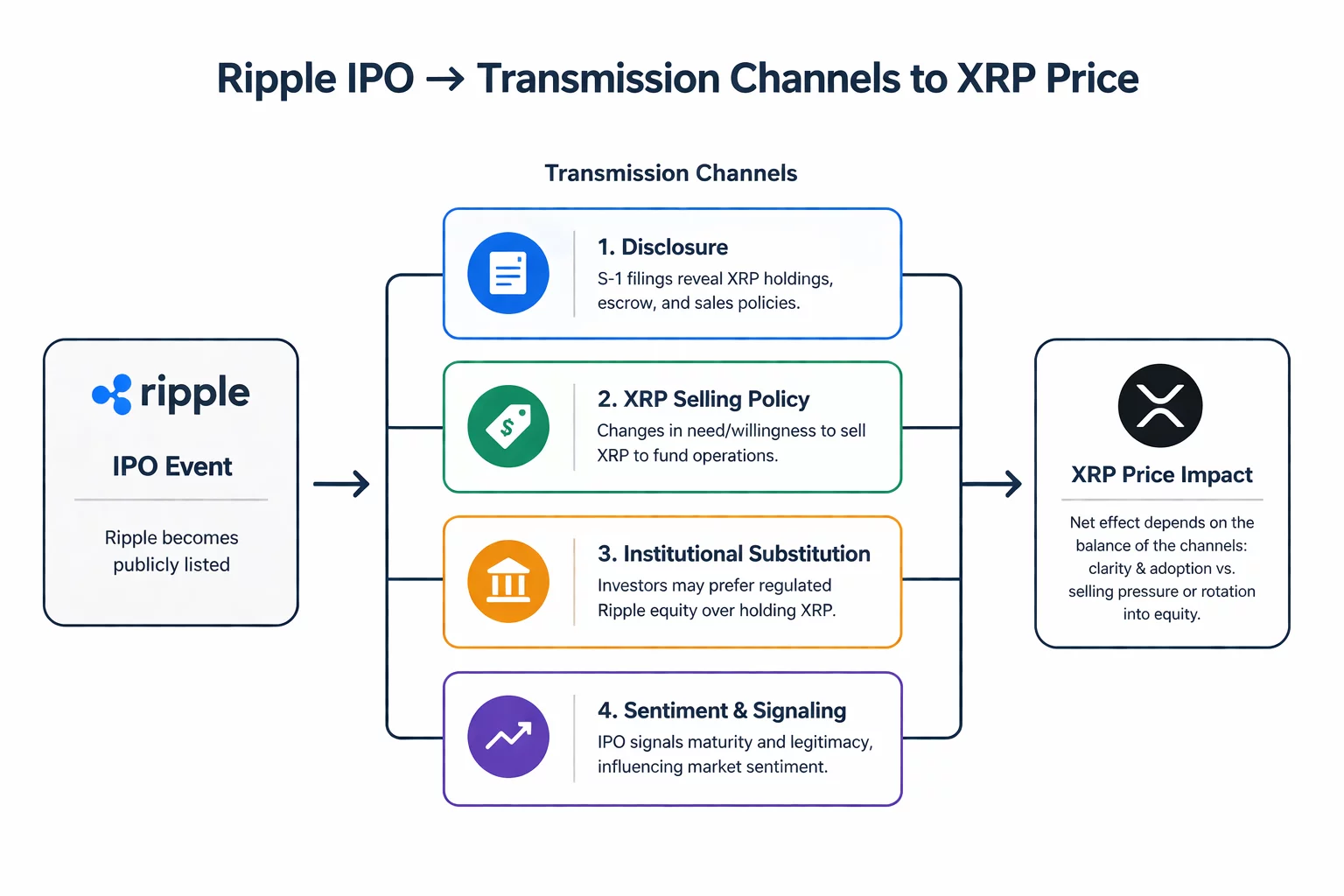
The more important effects are indirect, and they work through several channels:
- S-1 disclosure and XRP holdings transparency: A public Ripple would be required to disclose its XRP holdings and sales policy in detail in its SEC registration statement. This could either reassure or concern XRP holders, depending on what those disclosures reveal about Ripple's plans for its escrow releases.
- Operational XRP selling: If Ripple uses XRP sales to fund operations — which is one of the company's disclosed revenue mechanisms — a public filing would quantify that for the first time, potentially affecting how the market prices future XRP sell pressure.
- Institutional legitimacy and the "regulated exposure" trade: An IPO could attract institutional investors who want regulated crypto exposure via equity rather than direct token holdings. This creates a new buyer category for the Ripple story, but it is an equity buyer, not an XRP buyer. Some of that capital might otherwise have gone into XRP — creating a potential substitution effect that is modestly negative for the token.
- Sentiment and narrative momentum: The most immediate and largest effect of any IPO announcement would almost certainly be sentiment-driven. A successful Ripple IPO would validate the crypto industry's maturation narrative and likely trigger a broad XRP price rally in the short term — regardless of the fundamental mechanics described above.
The Most Likely Timeline
Based on the available evidence, here is a realistic timeline assessment for each major scenario:
2026 IPO (Low Probability)
For a 2026 IPO to happen, Ripple would need to file an S-1 registration statement no later than Q1 2026 to allow for the standard SEC review and roadshow process before markets close for the summer. Given that no such filing has been made public and leadership continues to signal a private preference, this would require a rapid reversal of stated strategy. Possible, but not the base case.
2027–2028 IPO (Moderate Probability)
A more plausible scenario involves Ripple continuing to grow its payment infrastructure business, allowing escrow releases to further reduce the XRP overhang, watching competitor crypto company IPOs to calibrate market appetite, and then filing when conditions are optimal. A 2027 or 2028 window would give the company time to fully resolve all remaining legal matters and build a cleaner financial profile for public-market scrutiny.
Staying Private Indefinitely (High Probability)
Given the current evidence — leadership statements, private capital access, active tender offer programs — the most honest assessment is that Ripple may simply not go public on any near-term timeline. Many of the world's most valuable companies have chosen to remain private indefinitely. For Ripple, the strategic calculus of avoiding quarterly earnings pressure, public disclosure of XRP sales activity, and the scrutiny that comes with SEC reporting may outweigh the benefits of a public listing for the foreseeable future.
Bottom Line for Investors and XRP Holders
The Ripple IPO narrative is compelling, and it is not without any foundation. The company is large enough, well-capitalized enough, and now legally clear enough to pursue a public listing if it chose to. The valuation scenarios are real, and the numbers are significant.
But compelling narratives and market realities do not always align. Right now, the strongest near-term signal from Ripple management is: stay private. XRP holders should treat IPO speculation as a potential upside catalyst, not as a fundamental pillar of their investment thesis. The token's value is driven by network adoption, on-chain utility, macro crypto sentiment, and supply dynamics — not by Ripple's equity listing status.
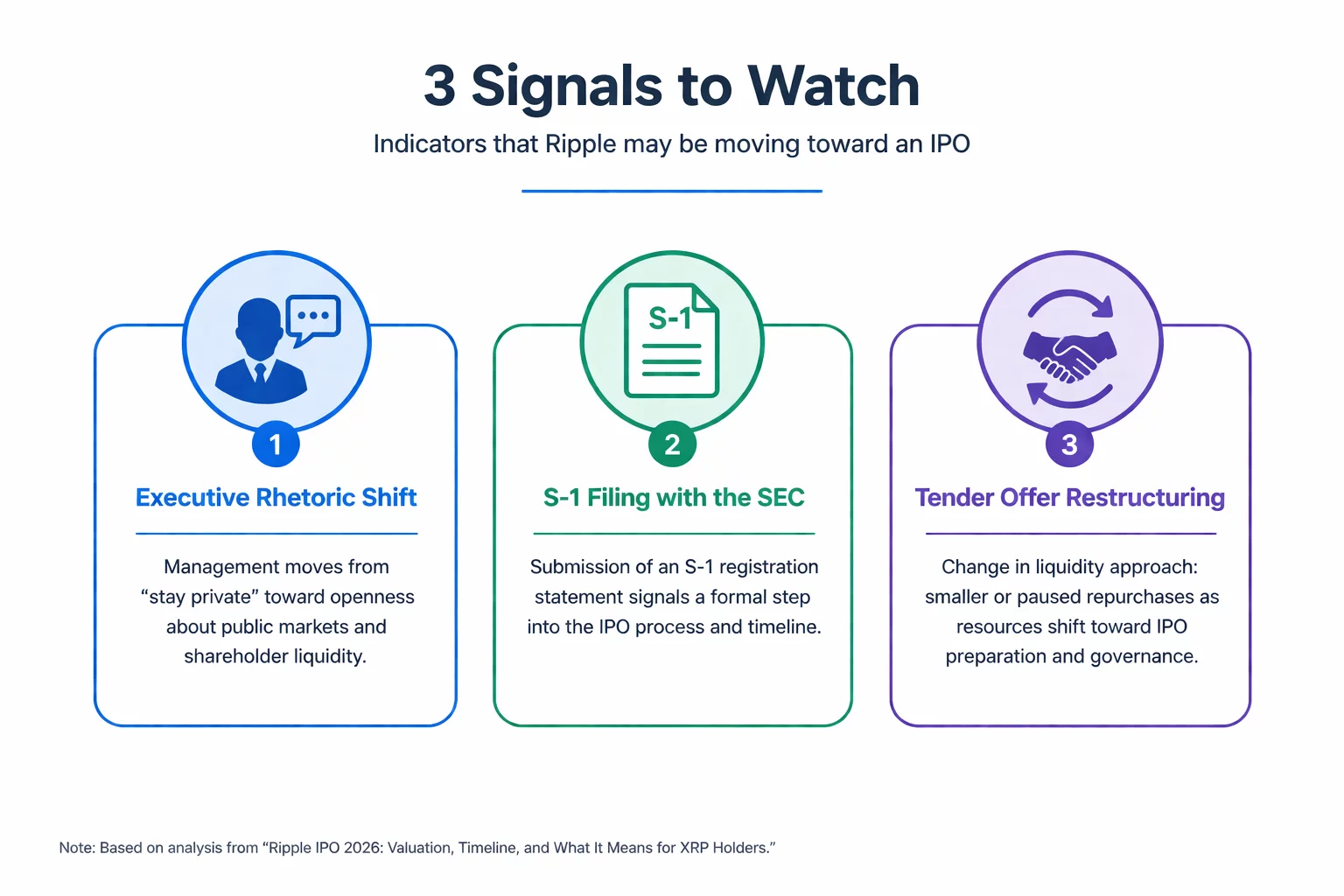
Watch for three concrete signals that would genuinely shift the probability assessment: a change in executive rhetoric on Bloomberg or at major conferences; a formal S-1 filing or public announcement of IPO preparation; or a significant restructuring of the tender offer program that suggests the internal liquidity mechanism is being wound down in preparation for a public market. Until at least one of those signals appears, 2026 remains a headline, not a date.
This article is for informational purposes only and does not constitute financial or investment advice. Always conduct your own research before making any investment decisions.
Frequently Asked Questions
Quick answers to the most common questions about this topic.

For educational purposes only. Nothing here constitutes financial or investment advice. Crypto markets are highly volatile — always DYOR before making any decisions.
Fact-checked per our editorial policy. We maintain strict independence from advertisers. Spot an error? Let us know.