

On April 12, 2026, President Donald Trump announced a full U.S. Navy blockade of the Strait of Hormuz after peace talks with Iran collapsed in Islamabad. Oil futures surged 7% within hours — and Bitcoin, caught in the crossfire of a macro shock, tumbled further from its weekend highs. Here's a complete breakdown of what happened, why it matters, and what it means for crypto markets going forward.
The Collapse That Changed Everything
For 21 hours across the weekend of April 11–12, U.S. and Iranian delegations sat face-to-face in Islamabad, Pakistan, in what many hoped would be the diplomatic endgame to a war that began on February 28. Vice President JD Vance led the American side; the talks were brokered by Pakistan and carried the weight of a fragile two-week ceasefire that had briefly lifted global markets just days earlier.
But the talks fell apart. Iran refused to abandon its nuclear ambitions, and its delegation demanded continued control over the Strait of Hormuz — the very chokepoint at the center of the entire crisis. Vance boarded Air Force Two and flew home empty-handed. Within hours, Trump was on Truth Social.
"Effective immediately, the United States Navy, the Finest in the World, will begin the process of BLOCKADING any and all Ships trying to enter, or leave, the Strait of Hormuz." — Donald Trump, Truth Social, April 12, 2026
Trump also instructed the Navy to intercept vessels that had already paid tolls to Iran and announced that U.S. forces would begin destroying mines Iran claims to have laid throughout the strait. He warned that any Iranian forces firing at U.S. ships or peaceful vessels would be "BLOWN TO HELL." U.S. Central Command confirmed the blockade would begin at 10 a.m. ET on Monday, April 13.
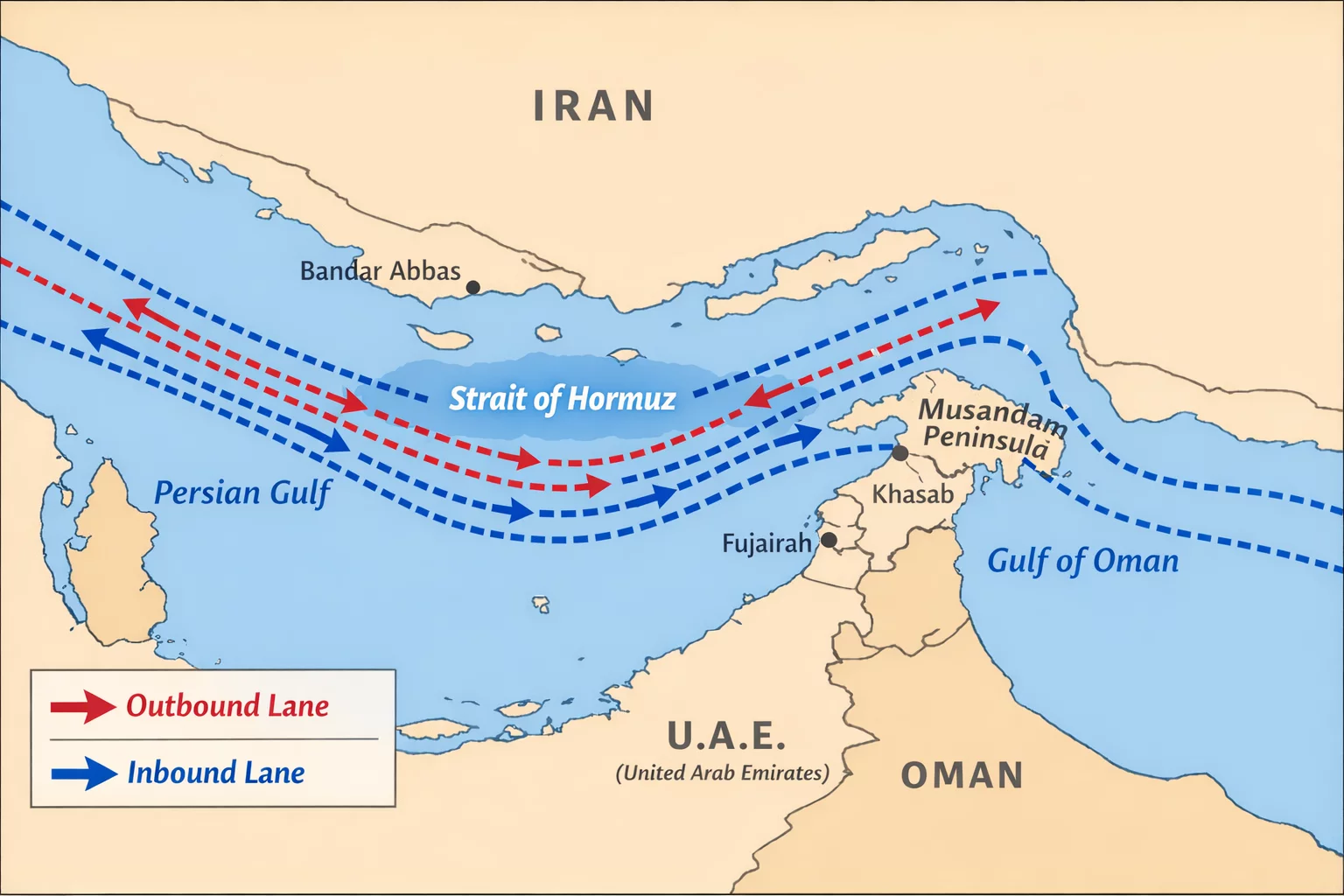
Why the Strait of Hormuz Is the World's Most Critical Chokepoint
To understand the scale of what Trump just triggered, you need to understand what the Strait of Hormuz actually is. This narrow waterway — roughly 21 miles wide at its tightest point, squeezed between Iran and Oman — is the single most important energy corridor on Earth.
Approximately 20% of the world's oil supply and a significant share of global liquefied natural gas (LNG) flow through the strait every single day. Before the conflict began, that amounted to roughly 20 million barrels per day. Since Iran began restricting access after the U.S.-Israeli strikes on February 28, that flow has slowed to what the International Energy Agency (IEA) described as "a trickle."
The consequences have been immediate and severe. Brent crude spiked above $100 per barrel in the initial weeks of the conflict, peaking near $120 during the most intense escalation in March. U.S. gasoline prices jumped over $0.50 per gallon on average. Inflation in the U.S. climbed to 3.3% in March, up sharply from 2.4% in February, with energy costs identified as the primary driver.
The IEA and allied nations have been draining strategic petroleum reserves at an unprecedented rate to compensate — but those buffers are now running dangerously low. A senior Columbia University energy scholar warned that the supply shortfall, currently running at 4.5–5 million barrels per day, could widen to 10–11 million barrels per day once reserves are exhausted. Saudi officials described such a scenario as "a supply shock without precedent in the modern oil market."
Markets React: Oil Surges, Bitcoin Slides
Because the blockade announcement came on a Sunday — when traditional commodity markets are closed — the first real-time price signals came from an unexpected source: Hyperliquid, the decentralized perpetual futures platform.
WTI crude perpetual futures on Hyperliquid jumped 7% to $96.40. Brent contracts rose 6% to $96. Total WTI trading volume on the platform reached $1.53 billion — making it the third most traded instrument on the platform, behind only BTC and ETH. The episode underscored a growing shift in how sophisticated traders use on-chain infrastructure for price discovery, particularly when traditional markets are offline.
Brent crude on traditional markets responded similarly when trading opened, rising roughly 8% to around $104 per barrel, extending what has already been an extraordinary run.
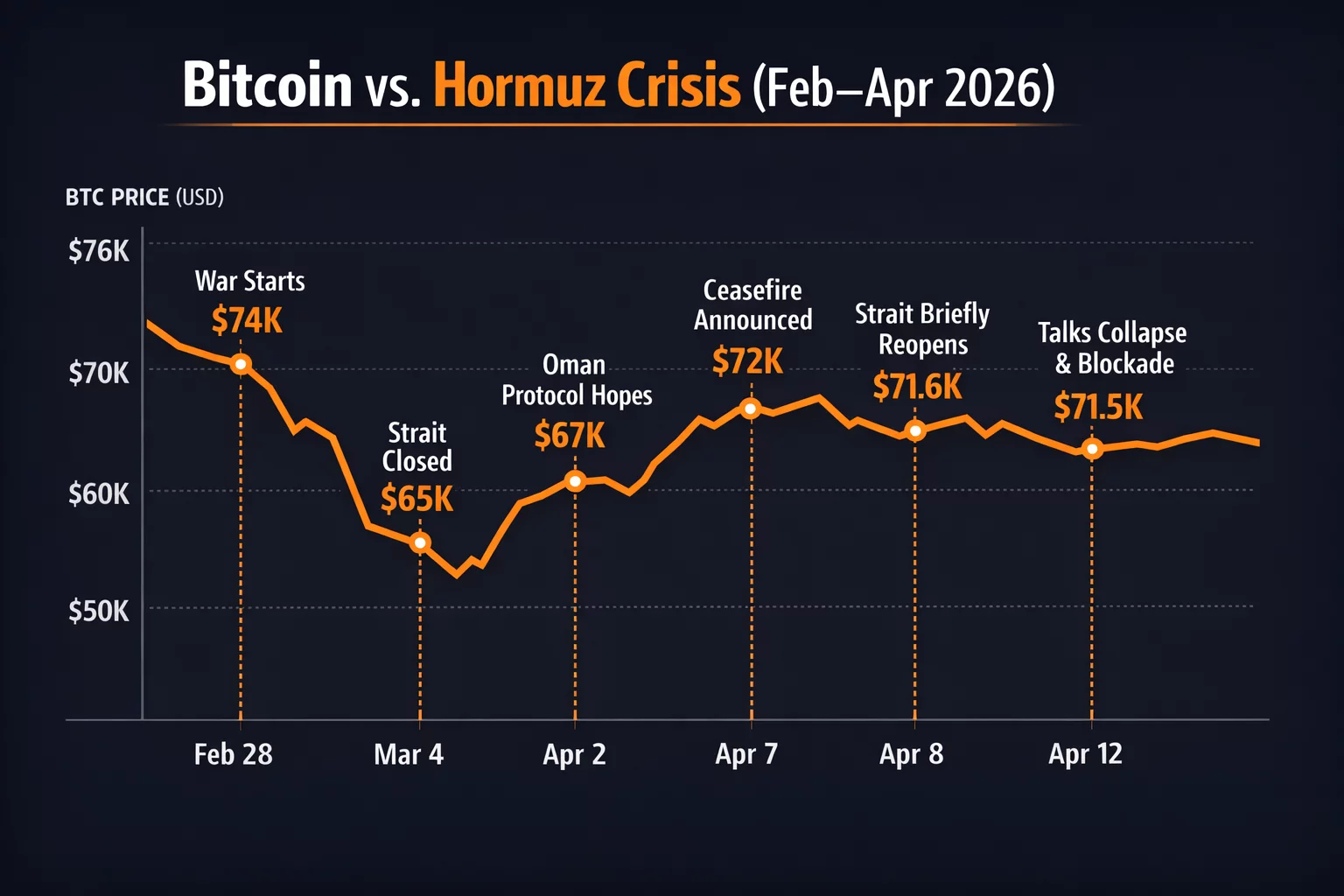
Bitcoin's trajectory told a parallel story — but in the opposite direction. BTC had been trading above $73,000 for most of Saturday, supported by lingering optimism that the Islamabad talks might yield a breakthrough. When Vance emerged and confirmed the talks had failed, BTC pulled back quickly to the $71,500 range. Trump's blockade announcement pushed it lower still, extending weekend losses as risk-off sentiment swept through crypto markets.
This pattern has been consistent throughout the six-week conflict. When the April 7 ceasefire was announced, Bitcoin surged from approximately $68,000 to above $72,000 within hours, while oil crashed 20%. When Iran closed the strait again within 24 hours — citing Israeli violations — BTC retreated to the $70,500 area. Now, with the blockade escalating tensions further, markets are repricing risk once again.
The Iran Crypto Toll Twist: A Geopolitical First
Amid all the bearish short-term pressure, one development has quietly captured the attention of the crypto industry: Iran's decision to accept cryptocurrency as payment for Strait of Hormuz transit tolls.
During the brief ceasefire window in early April, Iranian officials announced they would charge ships $1 per barrel of oil carried as a transit fee, with payments accepted in cryptocurrency (as well as Chinese yuan). The news sent BTC and Solana surging in the immediate aftermath — Bitcoin temporarily pushed above $72,700 before settling around $71,700.
The implications are significant. With tankers typically carrying between 500,000 and 2 million barrels of crude, and roughly 20 million barrels a day potentially transiting the strait, the theoretical daily Bitcoin demand from toll payments alone could reach tens of millions of dollars. More broadly, the arrangement represents something historically novel: a nation-state using cryptocurrency as a settlement mechanism for international energy trade under conditions where traditional financial systems are disrupted or sanctioned.
"When traditional financial rails are disrupted, alternative systems are not just theoretical. They are used." — VT Markets analysis, April 2026
Reports from Lloyd's List Intelligence confirmed that at least two vessels had already transited the strait by paying fees in Chinese yuan through Iran's Islamic Revolutionary Guard Corps (IRGC), which had established a de facto "toll booth regime" requiring ships to submit documentation and obtain clearance codes for escorted passage through a single controlled corridor. With the blockade now in effect, the future of these arrangements is uncertain — but the precedent has been set.
Short-Term Pain, Long-Term Signal
The short-term outlook for Bitcoin is challenging. Rising oil prices feed into broader inflation, which reduces the likelihood of Federal Reserve rate cuts — and potentially raises the prospect of further tightening. A higher-for-longer rate environment strengthens the dollar and increases the opportunity cost of holding non-yielding assets like Bitcoin. Institutional investors, facing margin calls on equity positions, have historically liquidated liquid assets — including BTC — to cover losses elsewhere. We saw this dynamic play out when Bitcoin fell from $74,000 to approximately $65,000 during the initial escalation in early March.
But analysts are careful to separate the short-term noise from the longer-term signal. Several structural factors are working in Bitcoin's favor, even in this environment:
- The "digital gold" narrative is back. Bitcoin has outperformed physical gold during multiple sessions throughout the Iran conflict, and it has maintained a floor well above its February lows near $60,000, even as equities faced severe drawdowns.
- Institutional infrastructure is expanding. Morgan Stanley launched its Bitcoin ETF on April 8, the same day as the ceasefire — and the timing reinforced the thesis that traditional finance is deepening its commitment to crypto regardless of geopolitical volatility.
- Crypto is becoming real settlement infrastructure. The Iran toll episode is not an isolated data point. Stablecoin transaction volumes exceeded $34 trillion in 2025, surpassing the combined volumes of Visa and Mastercard. In a world where sanctions, capital controls, and geopolitical conflict increasingly strain traditional payment rails, crypto's utility as a neutral settlement layer becomes more — not less — relevant.
- Decentralized price discovery is proving its value. The Hyperliquid episode this weekend demonstrated that on-chain markets can function as a real-time price signal for global macro events, even when traditional exchanges are closed. That functionality will only grow in importance.
What Happens Next
The immediate uncertainty is significant. Iran's IRGC has warned that any military vessels approaching the strait will be treated as a ceasefire violation. The UK confirmed it would not participate in the blockade — and is instead leading a 40-nation coalition focused on protecting freedom of navigation. Australia said it received no request to participate. The ceasefire's status is now officially in doubt.
Trump is also reportedly weighing a resumption of limited military strikes against Iranian infrastructure — desalination plants, electricity generation facilities — to increase pressure on Tehran. On Fox News, he described those targets as "very easy to hit." Whether or not that escalation materializes, energy markets are likely to remain elevated through at least the end of 2026, according to Columbia University's Center on Global Energy Policy.
For Bitcoin traders, the key variables to watch are oil price direction, any signs of renewed diplomatic engagement, and the Federal Reserve's response to inflation data in the coming weeks. A de-escalation scenario — even a partial one — could replay the April 7 dynamic: oil falling sharply, risk assets recovering, and BTC potentially testing the $76,000 resistance level that analysts had been eyeing before the ceasefire collapsed.

The Bottom Line
Trump's Hormuz blockade is not just a geopolitical event — it is a macro shock that is reshaping global energy markets, testing the limits of emergency oil reserves, and stress-testing the resilience of every risk asset class, including Bitcoin. In the short term, BTC is feeling the pressure alongside equities, as inflation fears mount and risk appetite retreats.
But the bigger picture is more nuanced. The Iran conflict has, almost by accident, accelerated two of the most important long-term trends in crypto: Bitcoin's emerging role as a geopolitical hedge, and cryptocurrency's quiet normalization as real-world settlement infrastructure in precisely the situations — sanctions, blockades, financial warfare — where traditional systems fail.
The Strait of Hormuz has become, unexpectedly, one of the most important places on Earth for crypto markets. And it isn't done moving prices yet.
This article reflects market conditions and publicly available information as of April 13, 2026. Nothing in this article constitutes financial advice.
Frequently Asked Questions
Quick answers to the most common questions about this topic.

For educational purposes only. Nothing here constitutes financial or investment advice. Crypto markets are highly volatile — always DYOR before making any decisions.
Fact-checked per our editorial policy. We maintain strict independence from advertisers. Spot an error? Let us know.