

Spot Bitcoin ETFs were supposed to be the finish line for Wall Street’s crypto ambitions. In reality, they look more like the opening bell. Once the industry proved that regulated, exchange-traded wrappers could bring digital assets into mainstream portfolios, the conversation shifted almost immediately from access to architecture: what comes after the first wave of adoption, and which part of the financial system is most likely to be rebuilt next? The answer is increasingly clear. The “post-Bitcoin ETF” era is not about a single next product. It is about the expansion of institutional crypto from a narrow investment theme into a broader market infrastructure story—one that now spans tokenized securities, stablecoin rails, compliant DeFi, AI-powered financial automation, and a renewed focus on digital security.
What changed after spot ETFs launched was not only investor sentiment, but the market’s center of gravity. Crypto stopped being treated purely as an offshore, retail-driven phenomenon and began operating more like an institutional macro asset class. That shift matters because Wall Street rarely stops at distribution. Once a new asset class is packaged, sold, and integrated into large portfolios, the next phase is usually deeper: trading infrastructure, collateral systems, custody, regulation, and eventually the tokenization of adjacent markets.
For crypto, that deeper phase is already underway. The next frontier for Wall Street is likely to be defined not by whether digital assets deserve a seat at the table, but by which parts of traditional finance will be re-engineered on blockchain-based rails first.
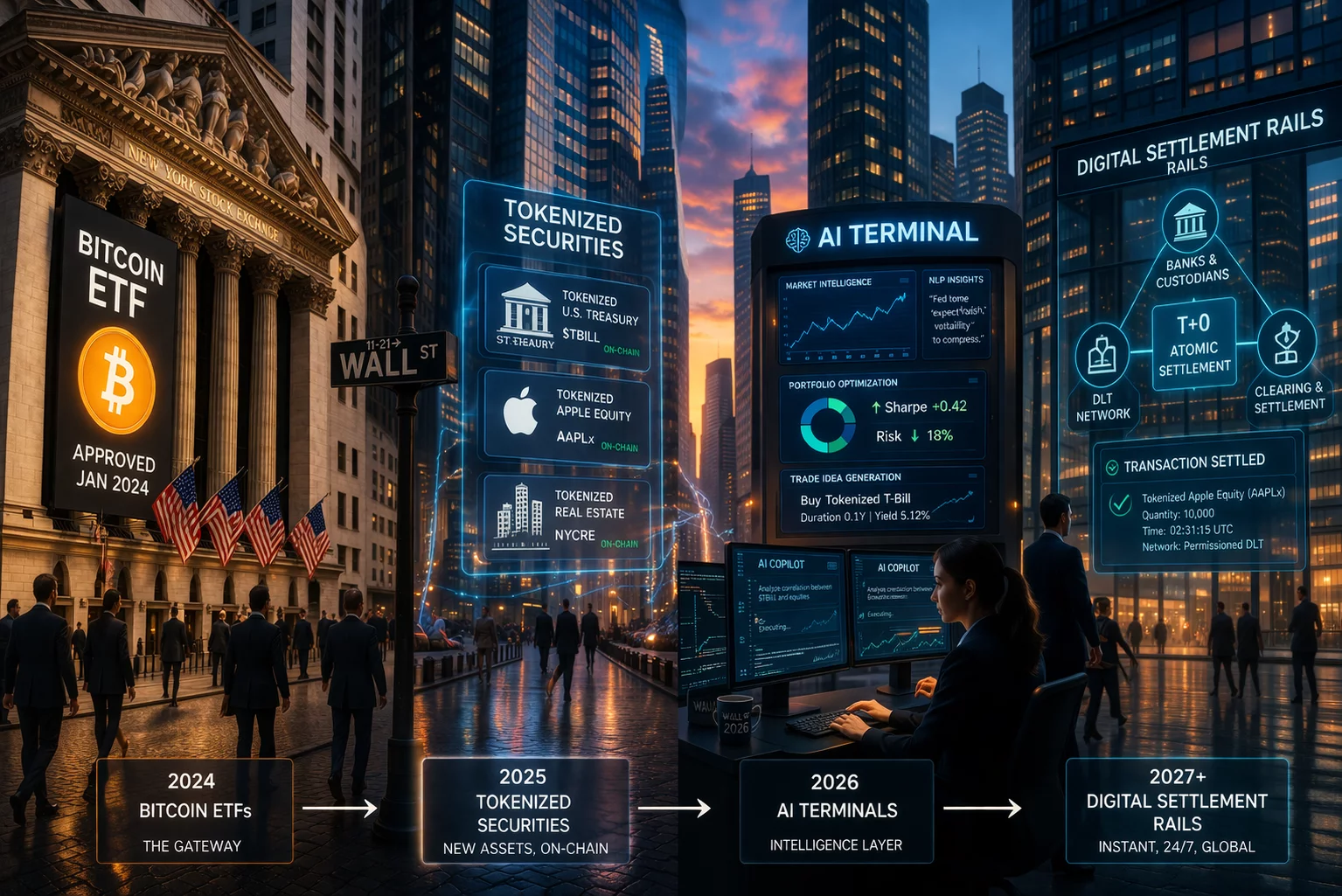
From breakthrough product to structural shift
The approval and scaling of spot Bitcoin ETFs changed more than the way investors buy exposure. They also changed the mechanics of the market itself. In the pre-ETF era, crypto’s price action was dominated by fragmented liquidity, offshore venues, and retail-heavy cycles. In the post-ETF era, price discovery has become more closely tied to regulated capital flows, U.S. trading hours, and institutional allocation frameworks.
That structural change has had two immediate consequences. First, volatility has moderated relative to earlier crypto cycles. Bitcoin remains volatile compared with most traditional asset classes, but the most extreme swings that once defined the market have become less frequent as ETF flows provide a more consistent source of demand. Second, liquidity has become more geographically concentrated, with U.S. market hours playing a much larger role in daily trading activity. In practical terms, that means crypto increasingly trades like a global asset priced through a Wall Street lens.
This is a crucial distinction. When a market’s center of gravity shifts toward regulated institutions, its future no longer depends only on narratives or retail enthusiasm. It starts to depend on balance-sheet efficiency, legal clarity, collateral utility, and integration with existing financial workflows. That is precisely why the post-ETF question is now so important. Once Bitcoin and, to a lesser extent, Ethereum gained mainstream wrappers, the next step was always going to involve the rest of the financial stack.
The next frontier is not another ETF alone
Wall Street will likely continue to expand crypto investment products. More index-based ETPs, multi-asset funds, and sector-specific baskets are a logical part of the market’s evolution. They offer allocators a familiar way to gain diversified exposure without managing wallets, protocol risk, or fragmented execution. But that product expansion is only part of the story.
The more consequential development is that institutions are moving from asking how to own crypto to asking how to use blockchain infrastructure. That distinction separates the first phase of adoption from the next one. The ETF era solved the problem of regulated access. The next era is trying to solve the problems of settlement latency, collateral inefficiency, cross-border frictions, fragmented custody, and limited market hours across traditional finance.
In other words, Wall Street’s next frontier is not just more exposure to digital assets. It is the application of tokenized, programmable market infrastructure to assets and processes that already matter to global finance.
Tokenization becomes a serious institutional business
If the ETF era brought crypto onto brokerage platforms, tokenization aims to bring traditional financial assets onto blockchain rails. This is the most obvious and arguably the most important frontier now opening up. Real-world asset tokenization—often shortened to RWA tokenization—has moved beyond proof-of-concept status and into an early industrial phase.
The core appeal is straightforward. Traditional markets still rely on systems that can be slow, siloed, and expensive to reconcile. Settlement may take a day or more. Collateral can sit idle. Access to certain asset classes remains constrained by high minimums, limited trading windows, or operational bottlenecks. Tokenization promises to address all three: it can make ownership more divisible, transfer more programmable, and settlement more immediate.
So far, the strongest traction has appeared in relatively straightforward financial products. Tokenized U.S. Treasuries, money market fund exposure, and private credit have gained momentum because they offer institutions a familiar risk profile with a potentially improved operational wrapper. In this model, the token is not merely a speculative instrument. It becomes a digitally native claim on a traditional asset, one that can move across interoperable systems and potentially be used as collateral in other transactions.
That collateral angle is especially important. For institutions, tokenization is attractive not only because it may broaden access or shorten settlement times, but because it can make assets more productive. A Treasury-backed token that earns yield and can also be deployed as high-quality collateral is more useful than a traditional instrument trapped in slower, less programmable infrastructure. This is where tokenization starts to look less like a crypto experiment and more like a market plumbing upgrade.
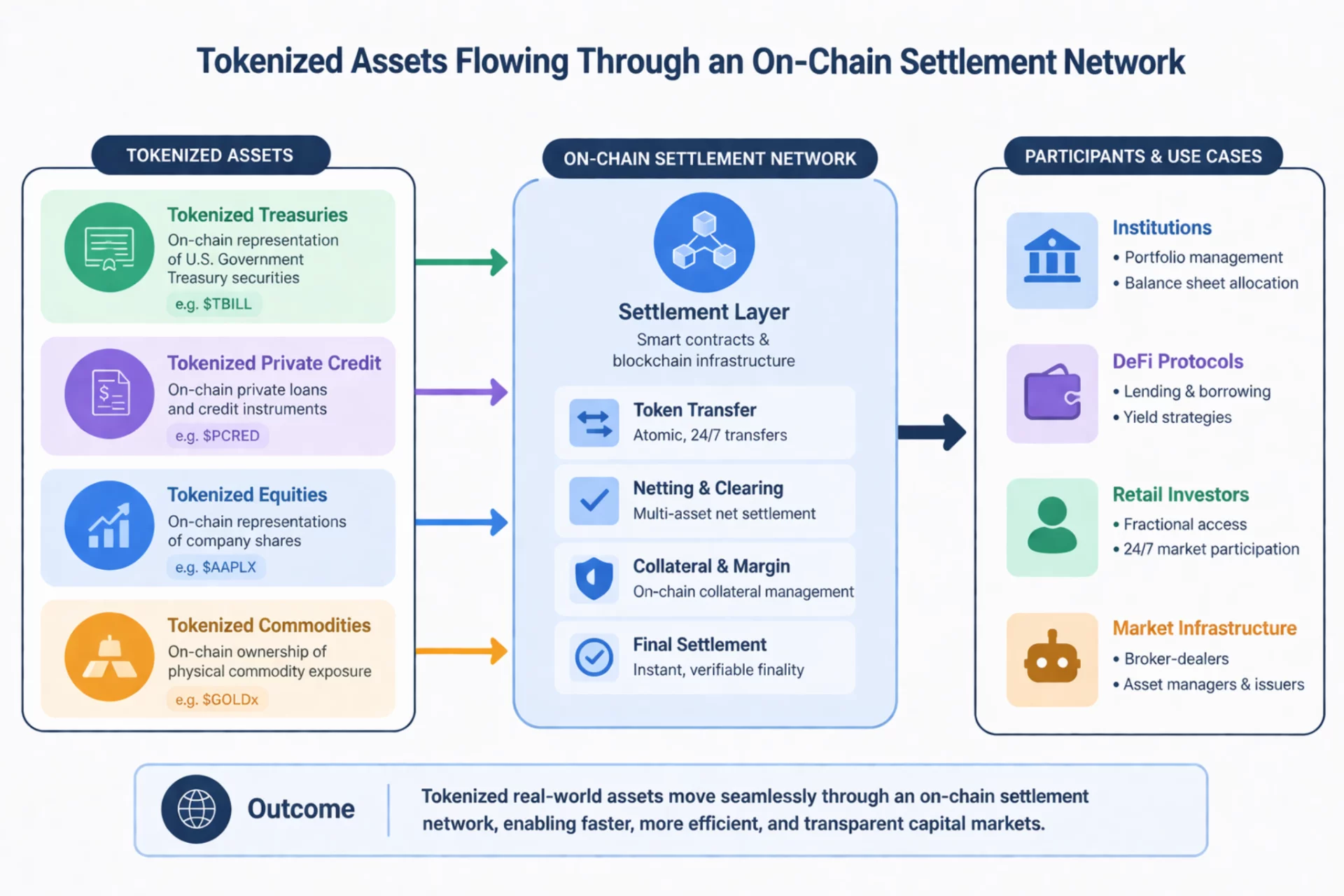
Equities may eventually become the most visible battleground. While tokenized stocks are still a small segment compared with traditional public markets, the strategic logic is compelling. A 24/7 or near-continuous market for tokenized securities would challenge long-standing assumptions about exchange hours, settlement cycles, and geographic barriers. For global investors, the ability to trade fractionalized, blockchain-based representations of major U.S. assets outside legacy market schedules could become one of the most commercially significant shifts of the decade.
That does not mean traditional exchanges disappear. More likely, they evolve. Existing market infrastructure providers have strong incentives to experiment with tokenized rails precisely because they do not want that future to be built entirely outside their walls. The post-ETF era is therefore not anti-Wall Street. It is Wall Street trying to ensure that, if markets become more programmable, incumbents still own critical parts of the stack.
Stablecoins move from edge case to financial rail
No institutional tokenization story works without reliable digital cash. That is why stablecoins have become such a central piece of the next frontier. For years, stablecoins occupied an uncomfortable position in U.S. policy debates: systemically important in practice, but often lacking clear federal rules. As regulation advances, that ambiguity is starting to narrow.
For Wall Street, stablecoins matter because they are not simply crypto trading tools. They are the settlement medium that can connect tokenized assets, cross-border payments, treasury operations, and on-chain financial applications. Once institutions become more confident that dollar-backed stablecoins will operate inside a formal regulatory perimeter, those instruments can start functioning less like a workaround and more like part of the financial mainstream.
The implications are broad. Stablecoins offer the possibility of near-instant settlement, round-the-clock transferability, and easier integration with tokenized collateral systems. For transaction banking, international commerce, and treasury management, that is a meaningful proposition. Cross-border payments remain one of the most obvious pain points in finance: costly, slow, and dependent on multiple intermediaries. A compliant stablecoin framework could reduce those frictions materially, especially when paired with tokenized bank liabilities or shared ledgers.
At the same time, the path is not frictionless. Institutions still need clear standards around reserve quality, redemption rights, operational controls, and compliance obligations. The post-ETF era is revealing a basic truth about digital finance: Wall Street can embrace innovation quickly, but only when the legal and operational rules are clear enough to support large-scale fiduciary participation.
Institutional DeFi sheds its retail image
Another frontier taking shape is institutional-grade DeFi. For many traditional firms, decentralized finance was long associated with unsustainable yields, anonymous counterparties, and legal ambiguity. That image has not disappeared entirely, but it is becoming incomplete. A new version of DeFi is emerging—one aimed not at retail speculation, but at regulated financial institutions that want the efficiency of smart contracts without abandoning compliance requirements.
This is where permissioned liquidity pools, whitelisted participation models, and tokenized liabilities come into view. Instead of treating DeFi as a parallel financial universe, institutions are beginning to test it as a programmable execution layer for specific use cases: collateral management, foreign exchange settlement, credit markets, and on-chain fund operations.
The appeal is obvious. Smart contracts can automate workflows that still require manual intervention or multiple intermediaries in traditional systems. They can reduce settlement risk through delivery-versus-payment models. They can allow assets to move more seamlessly between custodial environments and funding venues. And they can create financial products that update in real time rather than on end-of-day or multi-day cycles.
Still, institutional DeFi remains a qualified story rather than a fully mature one. The technology is improving faster than many governance and legal frameworks. Large pools of capital—especially pensions, insurers, and endowments—continue to move cautiously because enforceability, counterparty rights, and regulatory treatment are not always settled. That gap between technical readiness and fiduciary readiness is one of the defining tensions of the post-ETF landscape.
Even so, the direction of travel is clear. DeFi is no longer judged only by whether it can recreate banking functions outside traditional finance. Increasingly, it is being tested on whether it can improve financial processes within institutional settings.

AI becomes part of the market infrastructure story
Another reason the post-Bitcoin ETF era looks bigger than a product cycle is that it overlaps with the rapid rise of AI in finance. This matters because Wall Street’s next frontier may not be purely blockchain-based. It may be the combination of blockchain rails and AI-driven operational intelligence.
The financial industry is already moving from experimentation with generative AI toward more task-oriented, agentic systems. In practical terms, that means software capable not only of producing content or analysis, but of executing parts of a workflow: monitoring exposures, optimizing collateral, screening transactions, flagging compliance issues, or dynamically adjusting trading logic.
In crypto-native and tokenized environments, those capabilities become even more relevant. Programmable assets generate structured, machine-readable data. Smart contracts define explicit rules. Settlement can occur in near real time. That creates fertile ground for AI systems that can supervise, allocate, and optimize complex financial activity more continuously than human teams alone.
For trading desks, AI may improve execution quality, liquidity forecasting, and sentiment interpretation across fast-moving markets. For banks and asset managers, it may reduce onboarding costs, improve fraud detection, and streamline compliance monitoring. For regulators and internal risk teams, the promise is even more consequential: continuous supervision rather than periodic review.
This does not mean AI will replace institutional judgment. But it does suggest that the post-ETF era will reward firms that can combine regulated digital asset infrastructure with better automation. The firms that win may not be those with the boldest crypto narratives, but those that build the most effective operating systems around tokenized finance.
Security becomes a board-level issue, not a technical footnote
As more institutional capital enters digital asset markets, security shifts from a specialist concern to a strategic one. In the first phase of crypto adoption, the focus was often on hacks, key management, and custody failures. Those issues remain crucial, but the threat model is expanding.
One emerging theme is quantum risk. Even if practical quantum attacks against today’s cryptography are not imminent at scale, large institutions cannot afford to ignore the possibility. The “harvest now, decrypt later” scenario—where sensitive encrypted data is captured today in anticipation of more powerful computing tomorrow—has made post-quantum resilience part of long-term infrastructure planning.
That concern is layered on top of more immediate realities. As AI expands the attack surface across finance, cyber defense becomes more complex. Institutions need secure custody, robust transaction monitoring, resilient identity systems, and better protection for sensitive operational data. In a tokenized financial world, security is not merely about preventing theft. It is about preserving the integrity of ownership records, settlement finality, customer trust, and regulatory credibility.
For Wall Street, this creates a new competitive dimension. The most trusted platforms in the next cycle may be those that combine liquidity and product breadth with the strongest custody architecture, incident response, and future-proof security design.
Regulation is no longer a side story
Perhaps the clearest sign that the post-ETF era is structurally different from prior crypto cycles is the role of regulation. For much of the last decade, the industry often moved first and litigated later. That approach may have helped accelerate experimentation, but it also limited how much institutional capital could participate with confidence.
Today, regulatory developments are becoming one of the main drivers of market expansion. Clearer frameworks around stablecoins, market structure, custody, and jurisdiction do more than reduce legal risk. They effectively grant permission for large institutions to build products, deploy balance sheet, and invest in long-duration infrastructure.
That permission matters enormously. Asset managers, banks, exchanges, and payment companies do not need perfect regulatory harmony to move forward. But they do need enough certainty to justify capital expenditure, operational buildout, and client commitments. In this sense, regulation is not the opposite of innovation in the post-ETF era. It is increasingly the enabler of it.
There are still major open questions, from the exact boundaries between securities and commodities oversight to how tokenized financial claims should be treated across jurisdictions. But the trend is unmistakable: the center of the market is moving away from improvisation and toward formalization.
So what is Wall Street’s real next frontier?
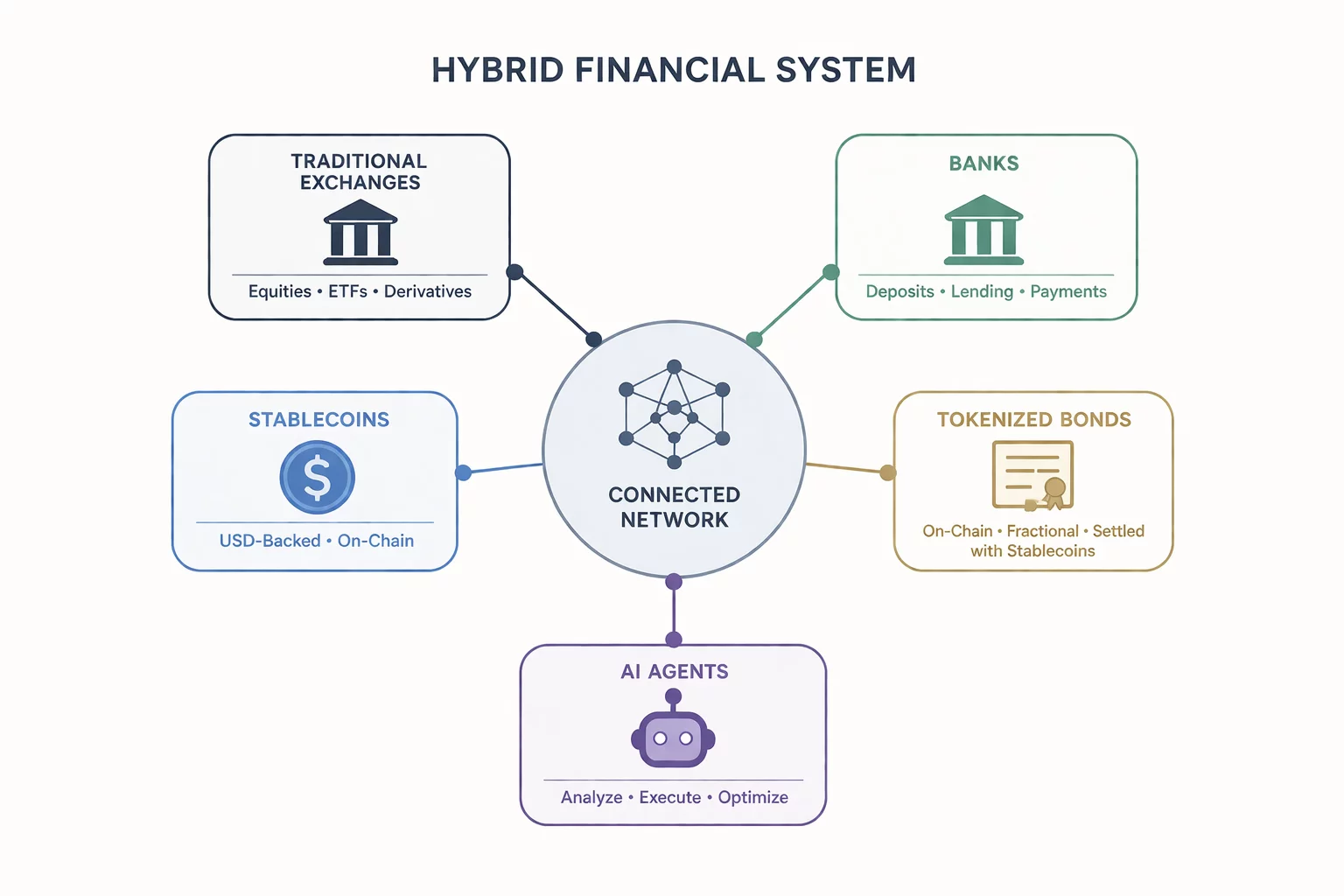
The answer is broader than “the next ETF,” even though more ETF innovation will almost certainly arrive. Wall Street’s next frontier is the gradual fusion of digital assets with mainstream financial infrastructure. It includes tokenized Treasuries and private credit. It includes stablecoins as settlement media. It includes permissioned DeFi for institutional workflows. It includes AI-driven market operations and new security frameworks built for a digital-first financial system.
Seen together, these themes point to a larger shift. The first crypto decade was largely about proving that blockchain-based assets could exist, survive, and attract capital. The post-Bitcoin ETF era is about proving that blockchain-based infrastructure can improve how capital markets actually function.
That is a much harder challenge—but also a much bigger opportunity. The winners may not be the firms that make the loudest predictions about price. They may be the ones that quietly modernize settlement, collateral, fund administration, treasury management, and compliance around digital rails.
Conclusion
Bitcoin ETFs marked a historic milestone, but they did not complete Wall Street’s crypto journey. They legitimized it. With that legitimacy came a new phase of competition—one focused less on whether institutions will participate, and more on which parts of financial infrastructure they will rebuild first.
In that sense, the post-Bitcoin ETF era is really the beginning of a broader institutional design race. Tokenization is competing to modernize asset issuance and settlement. Stablecoins are competing to become foundational payment rails. Institutional DeFi is competing to prove that smart contracts can reduce friction without sacrificing compliance. AI is competing to become the intelligence layer that makes digital finance scalable. And security architecture is competing to keep all of it trustworthy.
For investors, the next chapter will likely look less like a single headline catalyst and more like a slow but profound rewiring of finance. For Wall Street, that may be the real frontier at last: not simply bringing crypto into the old system, but using crypto-native tools to redesign the system itself.
Frequently Asked Questions
Quick answers to the most common questions about this topic.

For educational purposes only. Nothing here constitutes financial or investment advice. Crypto markets are highly volatile — always DYOR before making any decisions.
Fact-checked per our editorial policy. We maintain strict independence from advertisers. Spot an error? Let us know.